
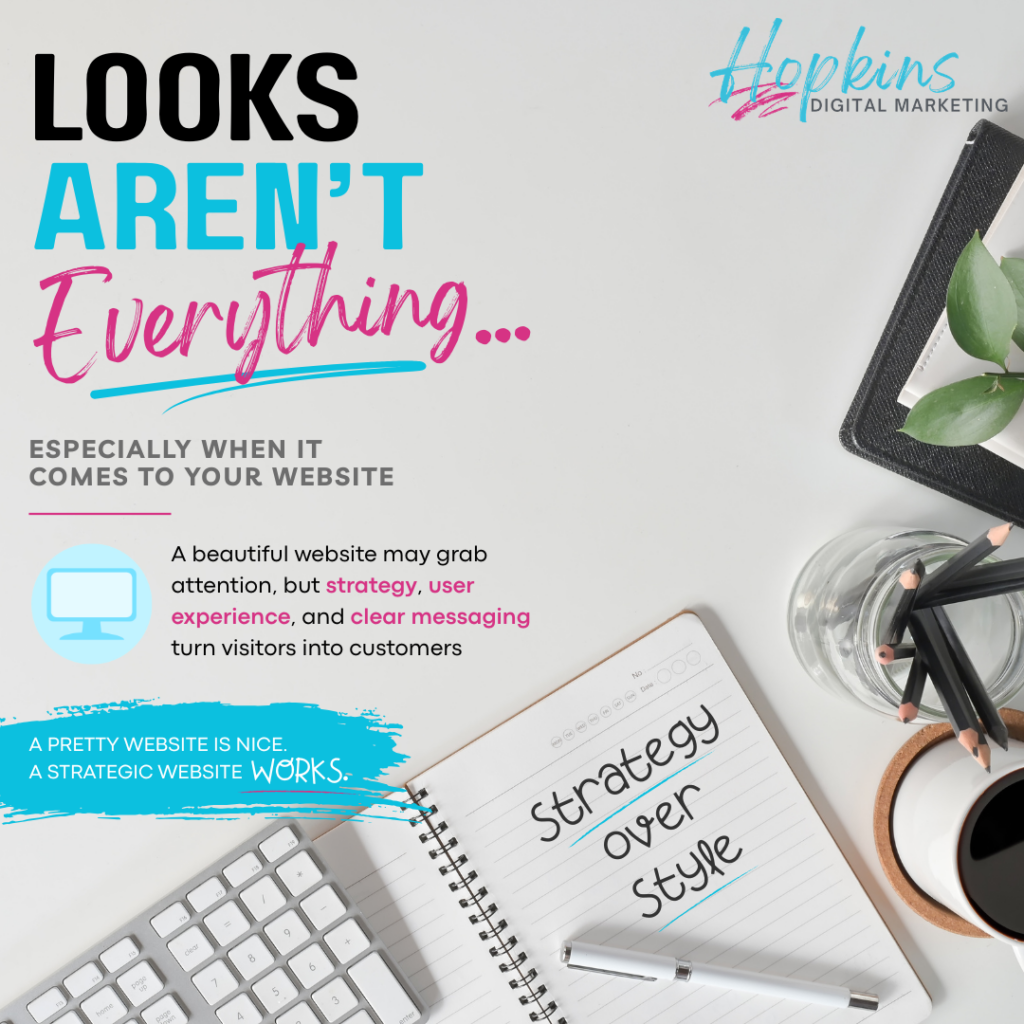
A Beautiful Website Isn’t the Same as an Effective One
Let’s get this out of the way: a gorgeous website is nice. (Who doesn’t love a little eye candy?)
But here’s the truth… pretty doesn’t always mean profitable.
If you think a beautiful site is all you need to attract clients, you might be falling for one of the oldest marketing myths in the book. A visually appealing website might grab attention, but it won’t keep visitors around OR turn them into customers on its own.
What Actually Keeps People on Your Website
The real magic happens behind the scenes.
Sure, a sleek design can pull people in. But if your visitors:
-
- Can’t find what they need
-
- Get confused by “creative” navigation
-
- Have to squint to read your font
…they’ll click away faster than you can say bounce rate.
What actually works? Here are a few website user experience tips that will keep people on your site:
-
- Clear, easy-to-understand messaging
-
- Simple, intuitive navigation
-
- Easy-to-find contact information
- Content that sounds human (not like it was written by a robot having a bad day)
You Have About 10 Seconds… Maybe
Studies show that users decide whether to stay or leave a website in less than 10 seconds.
No pressure, right? 
If your site looks great but doesn’t:
-
- Answer their questions
-
- Explain what you do
-
- Tell them what to do next
…they’re gone.
And here’s the kicker: websites that focus on user experience (UX) and clear calls-to-action consistently see:
-
- Higher engagement
-
- Lower bounce rates
-
- More conversions
Even when the design is simple.
The Websites That Win (Spoiler: It’s Not Just the Pretty Ones)
The best-performing websites do three things really well:
- Make visitors feel welcome
- Make them feel understood
- Make the next step obvious
That’s it.
So no, you don’t need to ditch the pretty. But you do need to make sure you’re not sacrificing substance for style.
Because your website should be more than a digital business card…
It should be your hardest-working team member (minus the coffee breaks  ).
).
Not Sure If Your Website Is Working?
Here’s a quick test:
Ask a friend (preferably one who won’t sugarcoat things) to click around your site and tell you about their website user experience:
-
- What they think you do
-
- Where they got confused
-
- Whether they’d actually reach out
You might be surprised what you hear.
Or… if you’d rather skip the awkward honesty, I’m always happy to take a look and give you some real, actionable feedback.
Let’s Turn “Pretty” Into “Pretty Effective”
Sometimes, it’s not about a full redesign.
A few simple website updates or tweaks such as:
-
- better messaging
-
- clearer calls-to-action
-
- improved structure
can make a huge difference in how your site performs.
Contact me, and let’s figure out how to make your website work harder… so your business doesn’t have to.
Frequently Asked Questions
What is a bounce rate?
A bounce rate is the percentage of visitors who leave your website after viewing only one page without taking any further action. A high bounce rate can indicate that visitors aren’t finding what they need, the content isn’t engaging, or the website experience is confusing. While bounce rate isn’t always a bad thing, it can be a useful metric for understanding how well your website is keeping visitors engaged and encouraging them to explore additional pages.
Why is user experience important for a website?
User experience (UX) refers to how easy and enjoyable it is for visitors to navigate and interact with your website. A positive user experience helps visitors find information quickly, builds trust in your business, and increases the likelihood that they’ll contact you, make a purchase, or take another desired action.
Can a simple website perform better than a complex one?
Absolutely. A simple website with clear messaging, intuitive navigation, and strong calls-to-action often outperforms a more complex website. Visitors generally prefer websites that make it easy to understand what a business offers and how to take the next step.
How do I know if my website is effective?
An effective website helps visitors accomplish their goals while supporting your business objectives. Signs of a successful website include steady traffic, low bounce rates, longer engagement times, completed contact forms, phone calls, online purchases, or other conversions that matter to your business.
Do I need a complete website redesign to improve results?
Not necessarily. Many website performance issues can be improved without a full redesign. Updating your messaging, improving calls-to-action, enhancing navigation, optimizing page speed, and making content easier to read can often have a significant impact on user engagement and conversions.
How often should I update my website?
Your website should be reviewed regularly to ensure information is accurate, content is current, and functionality is working properly. Adding fresh content (such as blog articles), updating services, improving SEO, and making periodic design or usability improvements can help maintain website performance and search engine visibility.